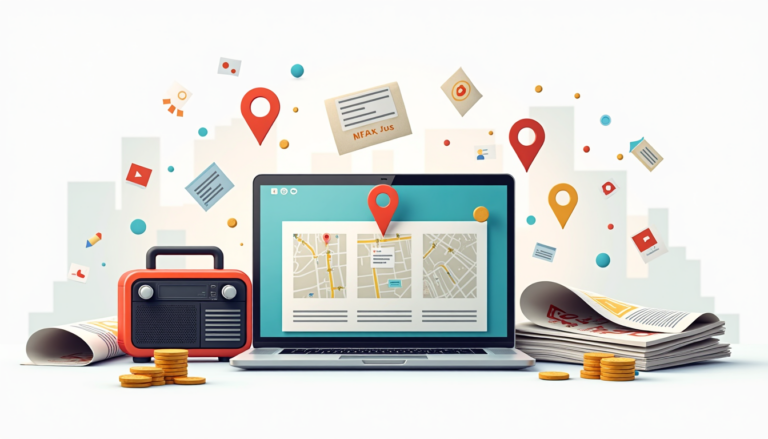
Over the years I’ve spent hundreds, if not thousands, on small business advertising channels like newspapers, magazines, and local radio. The return on investment has been poor at best. I have my theories, but instead of ranting I’ve asked AI to help me break down the real pros and cons of small business advertising channels: print, radio, Facebook, Google Business Profile, directory sites, email, cold calling, and your own website.
I already know that for my business, a solid website plus well-optimised Google Business Profile delivers the best ROI. Let’s see if the data backs me up. I’ll share my personal results after each section… so here goes.
Table of Contents
Print advertising (newspapers, magazines)
Print can still perform well for brand recall and response, especially in direct mail and niche titles. Studies show print and direct mail often generate higher response rates and ROI than generic digital display, partly because people trust and remember physical media more.
Pros
High attention & recall: People spend longer with print and are more likely to remember brands and offers.
Perceived credibility: Over half of consumers see print as the most trustworthy ad format, which can lift response.
Less clutter: In many local papers or niche magazines there’s less ad noise than on social feeds.
Strong for some audiences: Older, affluent, or traditional demographics may respond particularly well.
Cons
High cost per impression: Delivering print to thousands of people is far more expensive than showing digital ads to the same number.
Weak targeting for many locals: You often pay to reach a broad readership, not just your ideal customers.
Harder to track: You usually rely on custom URLs, codes or “how did you hear about us?” to measure results accurately.
Slow to test and iterate: Once the ad is printed, you can’t tweak the headline, offer or targeting without waiting for the next issue.
Risk of mismatch: If your service is something people only look for when they need it (plumber, IT help, etc.), your ad may be seen at the wrong moment and forgotten.
My Take: Print Advertising
I haven't done print for years now, and honestly, it never really worked for me. I steered clear of newspapers since they don't stick around homes long enough to make an impact unless you're willing to commit to a long term advertising campaign. But I did try local glossy magazines—dropped about €300 on a half-page ad, ran it over a few months. Zero responses I could tie back to it. I always ask new enquirers "how did you find me?" and it's invariably "I searched online." Tracking was tough even with unique offers, but the cost and lack of results made it easy to drop.

Flyers And Direct Mail
Flyers, leaflets and simple direct mail are still common for local businesses, especially in tight geographic areas. Handing or posting something through a door can put you in front of people who might never see your online ads.
Pros
Hyper‑local reach: you can target specific streets, estates or neighbourhoods that match your ideal customer.
Tangible and visible: a well‑designed flyer can sit on a kitchen table or noticeboard longer than a social ad stays in a feed.
Simple to execute: design, print, distribute – no need to learn ad platforms or dashboards.
Good for offers and events: discounts, openings, or time‑limited deals can get quick responses in the right area.
Cons
Very hit‑and‑miss: most flyers are binned within seconds, so you rely on volume for a small response.
Harder to measure: unless you use unique codes or URLs, it’s tricky to know exactly what came from a flyer.
Labour and print cost: design, printing and distribution add up, especially if you need multiple drops to be noticed.
No intent targeting: you’re pushing your message at everyone in a radius, whether they care or not.
My Take: Flyers
Tried this too—designed the flyers myself (so no extra design cost) with good production quality at a reasonable price, then stuffed them into local newspapers and magazines for distribution. Included special offers to track responses, but they felt forgettable. Most probably got chucked straight away. No real uptick in business I could point to, and the effort of designing/distributing just wasn't worth it compared to what I get from online channels that run 24/7.
Radio Advertising
Local radio still offers large local reach and can boost branded search and web visits when campaigns run. It can be powerful for broad consumer offers, especially when ads are frequent and well produced.
-
Pros
-
Big local reach: One campaign can reach a large percentage of adults in a given area.
-
Emotional impact: Voice, music and repetition build familiarity and trust over time.
-
Supports other channels: Radio activity often correlates with lifts in Google searches, website visits and store traffic.
-
Relatively quick to produce: Audio spots are usually faster and cheaper to make than full video.
-
-
Cons
-
Frequency cost: To be remembered, you need repeated plays; that frequency quickly becomes expensive for small businesses.
-
Attribution is fuzzy: It’s hard to prove exactly which calls or enquiries came from radio rather than other channels.
-
Broad not narrow: You pay to reach many people who will never need your specific service.
-
Message dependence: A weak script, unclear offer or hard‑to‑remember brand name kills response, no matter how many spots you buy.
-
Timing risk: Your ad runs at fixed times whether or not your ideal customer is listening at that moment.
-
My Take: Radio Advertising
I gave radio a proper go: a three‑month campaign, four spots a day, a little over €1,000 in spend—and it generated exactly one enquiry I could clearly link back to it. I actually like the idea of radio, but unless you’re prepared to throw serious money at it, and ideally be the only one in your niche on that station, the value just wasn’t there for me. In my case there were other advertisers offering similar services, which I think muddied the waters and diluted the message. I did try to make it trackable with a dedicated landing page and a specific deal mentioned in the ad, because without that you’re almost guessing unless you tell people “mention this advert to get your discount.” On top of the airtime, you’ve also got the cost of producing the ad itself—and if you want to keep things fresh, potentially creating new versions over time—so the total investment builds up very quickly compared to the trickle of measurable leads I saw.

Facebook And Social Media Ads
Social platforms allow fine‑grained targeting and quick experimenting with creatives and audiences. They are, however, interruption‑based channels, not intent‑based like search or Maps.
Pros
Detailed targeting: You can narrow by interests, behaviours, demographics and sometimes location.
Fast testing: It’s easy to A/B test headlines, images, offers and audiences.
Low barrier to entry: You can start with small budgets and scale what works.
Retargeting: You can follow up with people who visited your site or engaged with your content.
Cons
“Scroll” mindset: Users aren’t usually looking for your service; you’re interrupting them, so conversion rates are often low.
Vanity metrics: Likes, impressions and cheap clicks can look impressive while generating few real enquiries or sales.
Rising competition: In many sectors, costs per click and per lead have climbed as more advertisers pile in.
Short shelf‑life: Ads fatigue quickly; creatives burn out and need constant refreshing.
Platform dependence: Algorithm changes, account issues or policy shifts can suddenly damage performance.
My Take: Facebook Ads
I still dip into Facebook ads from time to time, but honestly, getting it right as a novice is tough and it can burn through your budget fast if you're not careful. Facebook guides you step-by-step, but it still feels overwhelming. The online gurus push spending hundreds on campaigns, but I've kept mine modest at around €30 per month. I've had some responses I could track, depending on the ad type, but my main gripe is that ads get scrolled past so easily—people are conditioned to keep scrolling, so you need to nail two things: grabbing attention instantly and ensuring it's shown to the right people through solid targeting. I see tons of small businesses relying solely on Facebook pages and posting in local groups, which is super time-consuming and pretty ineffective in my experience. Posting on your own business page can work okay if you've built followers or hit the right interests to appear in timelines, but manual posting eats hours. With some technical know-how, you can automate it using scheduling tools like Postiz or Mixpost (which I use)—that makes it more manageable, but even then, it's no match for the steady leads I get from channels with actual buyer intent.
Google Business Profile (Google My Business)
For local and service businesses, an optimised Google Business Profile (GBP) is often one of the highest‑ROI assets available. Local searches usually signal strong buying intent, and an accurate, complete profile significantly increases calls, website clicks and navigation requests.
Pros
High‑intent visibility: People search “service + near me” when they’re ready to book, call, or visit, which leads to high conversion rates.
Map pack exposure: Appearing in the top 3 map results is one of the most clicked spots in local search.
Strong trust signals: Complete, accurate listings get up to 7× more clicks and are 2.7× more trusted than incomplete ones.
Direct actions: An optimised profile can deliver 30–50% more phone calls and other high‑intent actions like messages and bookings.
Data‑driven: You get insights on searches, views and actions, making it easier to understand impact.
Cons
You don’t fully “own” it: Google controls the platform, features and policies; suspensions or spam attacks can cause sudden drops.
Ongoing work: You need to maintain accurate info, add photos, answer Q&As and consistently gather reviews to stay competitive.
Highly competitive in some sectors: In big cities or popular trades, standing out requires real effort and a good website behind it.
Review management: Handling negative or unfair reviews can be stressful and time‑consuming.
My Take: Google MyBusiness Page
For me, Google Business Profile is an absolute must-have, especially for local search—and I suspect it's only getting more important as people shift toward AI-powered searches over traditional ones. When I'm hunting for a service myself, credibility is everything, and certain signals stand out: a solid GMB profile, a professional website, a proper email address (not just Gmail), and reviews. I put real effort into earning those reviews because ones on independent platforms like Google or Trustpilot carry more weight than self-hosted ones. If you're also on Facebook, those reviews can even show up here too, adding extra credibility. Ultimately, no matter what other online tactics I use, everything funnels back to my website where I control the story, the offers, and the next steps. And the best part? It's completely free to set up and optimise.
Directory Websites
Generic and niche directories can still play a role, especially for citations and certain industries. But many small businesses overpay for “featured” listings that deliver little measurable value.
Pros
Easy extra visibility: You can appear where customers are already browsing for providers.
SEO citations: Consistent listings of your name, address and phone number help local SEO.
Low setup effort: Once your profile is filled in, it mostly runs on autopilot.
Niche directories: In some trades (e.g. specialised B2B, associations), sector‑specific directories can send high‑quality leads.
Cons
Mixed lead quality: Some directories drive “tire‑kickers” or pure price‑shoppers rather than loyal clients.
You’re renting space: The directory, not you, owns the platform, branding and often the customer data.
Pay‑to‑play upsells: Featured listings and lead packages can be expensive, with unclear or unreported ROI.
Competing with you in Google: Many directories rank in search results for your keywords, then charge you to access leads they intercepted.
Hard to differentiate: Your profile often looks similar to competitors’ unless the directory gives you rich content options.
My Take: Directory Websites
There are plenty of directory websites where you can list your business for free—Yelp is one of the most well-known, or just Google something like "great directory websites to list my business for free in my area." When you're just starting out and trying to build your online presence and drive traffic to your site, these can be genuinely useful. Established directories often rank higher in search results, which can get you visible sooner than waiting for your own site to climb the rankings. I still get the occasional enquiry through Yelp, which keeps it worth maintaining. I'm a big believer in making it as easy as possible for potential clients to find and contact you. That said, there are real drawbacks: you have to keep all your key details bang up to date across multiple platforms, which means juggling logins and edits. Worse, some sites scrape your info from your website or elsewhere, and if there's any inaccuracy, it gets copied and perpetuated everywhere, which can hurt your credibility if someone's trying to reach you.

Your Own Website
A professional, conversion‑optimised website is the one asset you can truly own and control. Multiple case studies show that small businesses who combine a good website with local SEO grow revenue significantly faster than those relying mainly on social profiles.
Pros
Full ownership: You control content, design, functionality and aren’t at the mercy of third‑party algorithms.
Conversion engine: Clear calls to action, good copy and trust signals turn visitors into leads and customers.
SEO potential: With local SEO, businesses often see higher conversion rates because visitors are actively searching for nearby services.
Compounding returns: A well‑maintained site can keep generating enquiries for years without paying per impression or per click.
Hub for everything else: GBP, social, email and even offline ads all perform better when they point to a solid website.
Cons
Up‑front work: Strategy, content, design, build, and technical setup all take time and expertise.
Ongoing maintenance: Updates, security, performance and content need attention to keep results improving.
DIY pitfalls: Many DIY sites suffer from poor structure, slow performance, weak content and compliance issues, which limit results and waste the owner’s time.
Needs traffic: A website with no promotion (GBP, SEO, ads, referrals) won’t deliver much on its own.
My Take: Your Own Website
Clearly I'm going to extol the virtues of having your own website—I won't disguise my bias here because making websites is a big part of what I do at All Tech Plus. It's my shop window, my year-round advert that costs me very little to maintain, steadily brings in clients, and ticks that crucial 'credibility' box I mentioned earlier. A business still running off a free Hotmail or Gmail account? That immediately tells me something's off—it's a massive piece of the professional puzzle. Your site works for you 24/7, and when coupled with something like an AI assistant from AICognitio.com, it can handle client queries, take bookings, process sales, and more without you lifting a finger. Sure, you could build your own, but if web development isn't your expertise, it'll probably show in the final product—poor design, weak conversions, or endless tinkering. If a full bespoke site feels like too much upfront investment, I'd recommend starting simpler: a sharp one-page site built for you, bundled with one of my AICognitio plans as the perfect entry point. Like any advertising channel, a website needs maintenance—updates, fresh content, security—to keep drawing eyes to your shop window. But ask yourself: what's your time worth? What do you charge per hour? Outsourcing that to someone who lives and breathes this stuff is cheaper in the long run and lets you focus on what you do best—running your business.
Email Marketing & Newsletters
Email is less flashy than social or print, but it remains one of the most cost‑effective ways to stay in front of people who already know you. Because you’re talking to past or potential customers who opted in, open and response rates can be high compared to cold advertising.
Pros
Low cost per send once you’ve built a list, making it ideal for regular updates and offers.
Highly targeted: you can segment by interest, past purchases, or location and tailor messages.
Relationship‑building: consistent, useful emails keep you “top of mind” for when they finally need your service.
Easy to track: you see opens, clicks and replies, so you know what resonates and can refine over time.
Cons
Requires a list: you need a way to capture email addresses (website forms, lead magnets, in‑person signups), which takes effort.
Deliverability issues: poor list hygiene or spammy content can land you in junk folders and waste your effort.
Content demands: useful, non‑annoying emails need thought and time; blasting offers too often can cause unsubscribes.
Not great for instant, cold reach: email shines at nurturing relationships, not at magically finding brand‑new strangers.
My Take: Email Marketing
Email marketing has two sides, and I've worked both. First, newsletters—they're brilliant for ecommerce, content publishers, repeat‑business shops, or community sites. You build a list by promising exclusive content like special offers or new articles, nurturing those 'warm' subscribers who are already interested. Platforms like MailChimp and MailerLite make it easy; I've used both and even took a MailerLite course to better serve my own clients. They're trackable—link clicks, everything—which is miles ahead of unmeasurable print or radio. But they demand consistent time and dedication to create content people actually want. The second angle is outreach: using email to cold(ish) pitch businesses. Getting the message right is tricky—even with my strong written English, crafting compelling emails takes serious time. These days I mix tools to make it efficient: Facebook lead gen feeding into Twenty CRM, n8n automations, and AI models trained on my style and offerings to draft outreach emails. I edit them manually before sending, which saves hours. Carefully crafted emails are designed to drive clicks to your site, ordering pages, or further information—I don't use underhand tracking pixels in the emails themselves so I'm not tracking opens, but I can see all the traffic on any links I include. It's effective for reaching potential clients, but email still shines brightest as a nurturing tool once you've got website or GBP leads in the system—far better than starting from scratch with strangers.

Cold Calling
Cold calling means phoning people or businesses who haven’t asked to hear from you and trying to generate interest on the spot. It can still work in certain B2B and high‑value service contexts, but it has clear limits for most small local businesses.
Pros
Direct, personal contact: you speak to a human, handle objections in real time, and adjust your pitch on the fly.
Fast feedback: within a day of calling, you know if the pitch, offer or target list is resonating or needs changing.
Useful for B2B and high‑ticket offers: a single good conversation can lead to a long‑term client, making the time worthwhile.
Can open doors: even when it doesn’t close a sale, it can lead to follow‑up meetings, quotes, or permission to send more info.
Cons
Time‑intensive: you burn a lot of hours to reach a small number of genuinely interested people.
Low hit‑rate: most calls go to voicemail, gatekeepers, or people who are simply not interested right now.
Intrusive perception: many people dislike unsolicited calls, which can harm your brand if done aggressively.
Legal and compliance: you need to respect do‑not‑call rules, data protection, and consent requirements, especially when using lists.
Doesn’t scale like digital: you’re limited by how many quality calls you (or a team) can make, whereas a good website + GBP can handle many enquiries at once.
My Take: Cold Calling
Anyone (including me) who's worked in a call centre before will know how difficult and demoralising it is cold calling potential clients—particularly if you're using a database of poorly chosen prospects. People are suspicious, and rightly so, when they get a call out of the blue, often at inconvenient times. I'm not one for inconveniencing people; it's just not my thing. Sure, there are companies that will run cold calling campaigns for you (likely expensive), or you could go down the automation route—I have experience creating voice assistants, and it's absolutely possible to get AI doing outbound calling these days. The voice production is genuinely excellent now, and AI keeps improving. But even an outbound cold calling AI setup is likely to run you €1,000+ so definitely not viable for smaller businesses. For me, it's no match for a website and GBP generating qualified enquiries around the clock without the hassle or ethical headaches.
-
ROI
Return On Investment Money earned back vs money spent on ads. -
GBP
Google Business Profile Free Google Maps/local search listing (was Google My Business). -
Map Pack
Map Pack Top 3 Google local results with map - highest clicks. -
Citations
Citations Business name/address listings across directories (helps SEO). -
Vanity Metrics
Vanity Metrics Likes/impressions that look good but don't = revenue. -
Ad Fatigue
Ad Fatigue People ignore ads they've seen too often.
Conclusion: The Own vs Rent Decision
After years of testing every channel from print ads to cold calls, one truth stands out clearly: channels you rent demand constant cash or effort, while channels you own quietly compound value over time.
Print, flyers and radio felt like expensive shots in the dark—measurable results were rare despite the spend. Facebook delivered sporadic clicks but endless scrolling past my message. Directories helped early on but became maintenance headaches with scraped errors. Cold calling was demoralising drudgery. Even email, my strongest “rented” channel, works best nurturing leads that originate elsewhere.
The clear winners? Google Business Profile + Your Own Website. GBP captures high-intent “near me” searches for free, while your website controls the narrative, builds credibility, and converts 24/7. Together they create a self-reinforcing lead engine—GBP drives traffic, website closes the deal, reviews strengthen both. Add smart email nurturing or an AI assistant, and you’ve got a complete system.
I’ve wasted enough time and money learning this the hard way. Other businesses don’t need to.
Ready to build yours right?
Start simple with my AICognitio.com Site Starter plans—AI-powered one-page sites with chatbots that handle enquiries automatically. Or contact me at All Tech Plus for fully bespoke web development tailored to your business.
Your customers are searching right now. Make sure they find your professional presence, not a competitor’s Facebook page.
What channels have you tried? Share your wins and flops in the comments—I’d love to compare notes.